
Protect Your Business from Business Email Compromise (BEC)

Updated: Jun 16
Cybercriminals are no longer just targeting giant corporations. Small and mid-sized businesses across the country are being hit every day by a growing threat called Business Email Compromise (BEC). For many companies, it only takes one fake email, one rushed payment, or one employee trusting the wrong message to create a financial disaster.
At GingerSec, we’ve seen businesses become targets simply because attackers know employees are busy, distracted, and constantly communicating through email.
What Is Business Email Compromise?
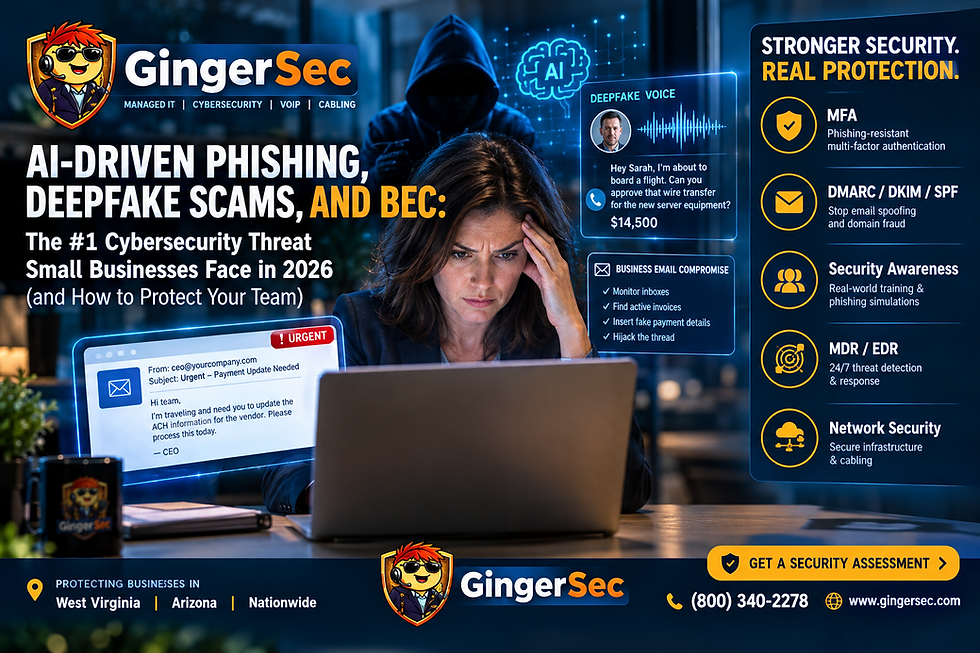
Business Email Compromise is a type of cyberattack where criminals impersonate a trusted person or company through email. Their goal is usually to trick someone into:
Sending money
Changing banking information
Purchasing gift cards
Sharing sensitive company data
Resetting passwords or account access
Unlike traditional phishing emails full of spelling errors and obvious scams, BEC attacks are often highly convincing. Attackers study companies, employees, vendors, and executives before launching the attack.
The email may appear to come from:
The company owner
A manager or supervisor
A vendor
A customer
An accountant
A shipping provider
Even Microsoft 365 or Google Workspace
How These Attacks Usually Happen
A typical Business Email Compromise attack looks something like this:
Your accounting employee receives an email from what appears to be the company owner.
“Hey, I’m in meetings all afternoon. Can you wire this payment before 3 PM?”
The email looks legitimate. The name matches. The signature looks real. Maybe the attacker even copied previous email formatting from a compromised account.
The employee sends the payment. Thirty minutes later, the business realizes the money went directly to a criminal account. At that point, recovery becomes difficult — and sometimes impossible.
Why Small Businesses Are Prime Targets
Many small businesses believe attackers only care about large corporations. Unfortunately, the opposite is often true. Smaller organizations typically:
Have fewer cybersecurity protections
Lack formal approval processes
Use shared passwords
Depend heavily on email communication
Trust employees to “just handle it quickly”
Attackers know this. They also know that many businesses operate fast. When someone sees an urgent email from a boss, vendor, or customer, they often react before verifying the request.
Common Warning Signs
Business Email Compromise emails often include:
Urgent requests
Pressure to act quickly
Requests to keep things confidential
Slightly altered email addresses
Last-minute banking changes
Unexpected invoices
Requests for gift cards or wire transfers
One of the biggest red flags is urgency. Attackers want people rushing instead of verifying.
Real-World Example
A company receives a message from a vendor they’ve worked with for years. The email says:
“We recently changed banks. Please update our ACH information for future invoices.”
Everything looks normal. The next invoice gets paid. Except the vendor never sent the message. The payment disappears into a fraudulent account, and the business still owes the original invoice to the real vendor. Now they’re paying twice.
How Businesses Can Protect Themselves
The good news is that Business Email Compromise is preventable when businesses put the right processes in place.
1. Enable Multi-Factor Authentication (MFA)
MFA adds an extra layer of protection to email accounts and dramatically reduces the risk of compromised accounts.
2. Verify Financial Requests
Never trust email alone for:
Wire transfers
Banking changes
Gift card purchases
Payroll updates
Always verify requests through:
A phone call
Microsoft Teams
An in-person conversation
A known contact method
3. Train Employees Regularly
Cybersecurity awareness training is critical. Employees should understand:
Phishing tactics
Fake login pages
Spoofed email addresses
Social engineering techniques
4. Use Email Security Protection
Advanced email filtering can block:
Impersonation attempts
Malicious links
Suspicious attachments
Domain spoofing
5. Create Internal Approval Policies
Require multiple approvals for:
Large payments
Vendor banking changes
Payroll modifications
Financial transfers
Even a simple two-person verification policy can stop many attacks.
The Biggest Mistake Businesses Make
The most dangerous phrase in cybersecurity is:
“That would never happen to us.”
Attackers don’t need to hack an entire company network if they can simply convince one employee to click, reply, or send money. Business Email Compromise attacks work because they exploit trust — not just technology.
Final Thoughts
Cybercriminals are becoming smarter, faster, and more convincing. Business Email Compromise attacks are now one of the most financially damaging cyber threats facing businesses today.
The companies that avoid becoming victims are usually the ones that:
Train employees
Verify requests
Use proper security protections
Take cybersecurity seriously before an incident happens
At GingerSec, we help businesses strengthen email security, improve employee awareness, and reduce the risk of costly cyber incidents before they happen. Because one fake email should never be able to shut down a business.
Additional Resources
Understanding Cybersecurity Threats
In today’s digital landscape, understanding the various cybersecurity threats is crucial. Cybercriminals are constantly evolving their tactics. Staying informed about these threats can help you better prepare your business.
The Importance of Cybersecurity Training
Regular training sessions can empower your employees. They become the first line of defense against cyber threats. Understanding how to recognize phishing attempts and suspicious emails is vital.
Implementing a Cybersecurity Policy
Creating a comprehensive cybersecurity policy is essential. This policy should outline the protocols for handling sensitive information, reporting suspicious activity, and responding to incidents.
Keeping Software Updated
Regularly updating software is one of the simplest yet most effective ways to protect your business. Outdated software can have vulnerabilities that cybercriminals exploit.
Engaging with Cybersecurity Experts
Consider consulting with cybersecurity experts. They can provide tailored advice and solutions to enhance your security posture.
For more information on how to protect your business from cyber threats, feel free to Contact GingerSec.


Comments