
AI-Driven Phishing, Deepfake Scams, and BEC: The #1 Cybersecurity Threat Small Businesses Face in 2026 (and How to Protect Your Team)

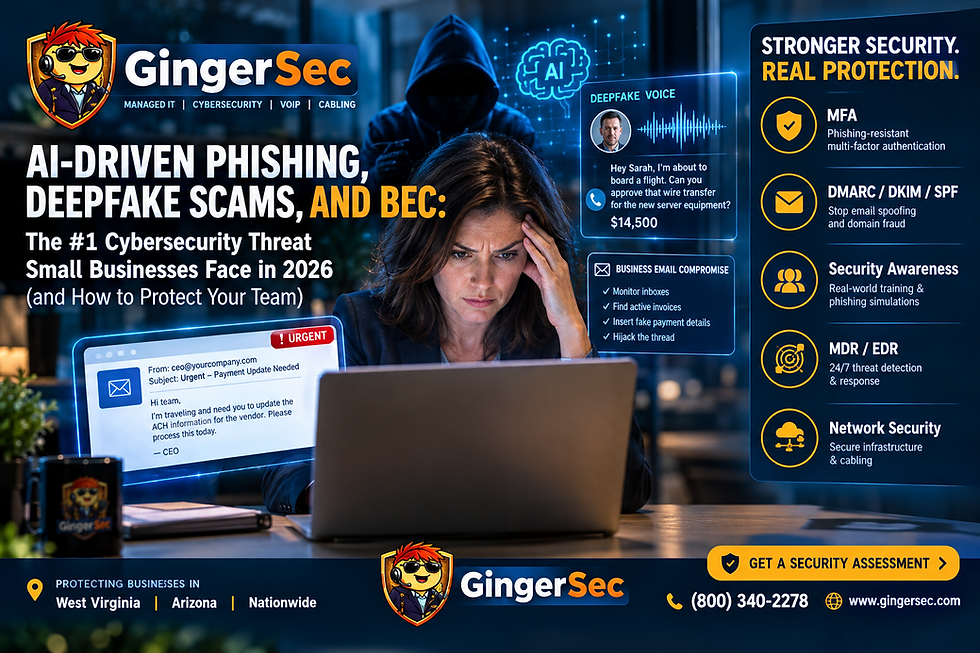
If you own or manage a business in West Virginia, Arizona, or anywhere across the United States, you’ve likely noticed a drastic change in the threat landscape.
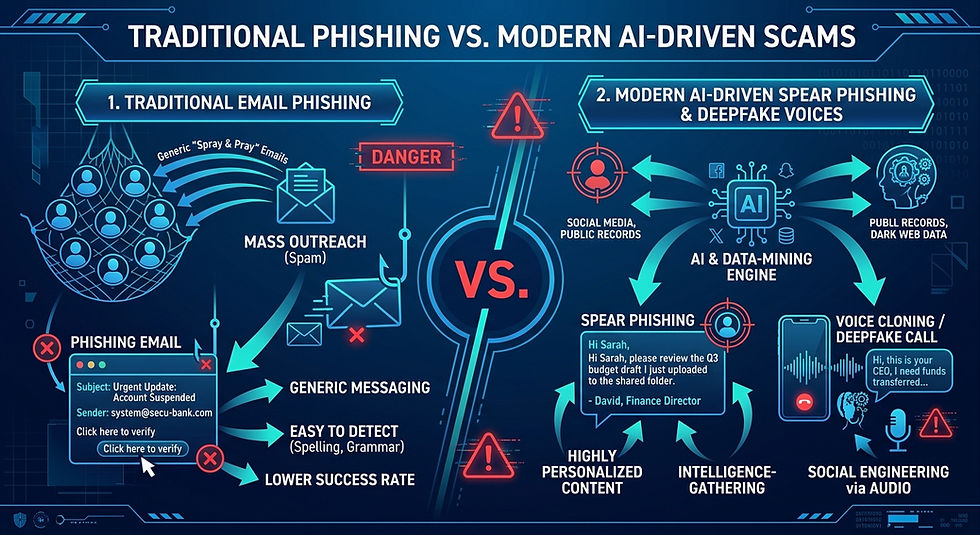
The era of obvious, typo-ridden scam emails from "foreign princes" is officially dead. In 2026, cybercriminals aren’t relying on crude scripts—they are leveraging large language models (LLMs), deepfake voice synthesis, and automated social engineering toolkits to target small and mid-sized businesses (SMBs).
Many business owners still believe: "We’re just a local business with 25 employees; why would a hacker target us?"
The reality is that AI tools have made targeted attacks so cheap and scalable that small businesses are now the primary target. Automated AI agents crawl the web 24/7, harvesting public employee data, mapping vendor relationships, and launching tailor-made attacks against local organizations every single day.
In this deep dive, the cybersecurity team at GingerSec, LLC breaks down how these modern AI threats work, why traditional defenses fail, and the exact multi-layered security framework your organization needs to stay protected.

1. How AI Transformed Social Engineering in 2026
Social engineering is the practice of manipulating people into handing over confidential information, credentials, or funds. AI has elevated this tactic into a high-precision weapon through three main avenues:
A. Hyper-Personalized "Spear Phishing"
Historically, writing a custom, convincing email to impersonate a vendor or executive required significant research and effort. Today, cyberattackers feed public data—LinkedIn profiles, corporate press releases, vendor announcements, and social media activity—into specialized AI tools.
In seconds, the AI generates a context-aware email that perfectly matches the writing style, tone, and vocabulary of your company’s CEO, CFO, or key vendor.
Example: An email arrives from your actual HVAC contractor’s domain (or a visually identical spoofed domain) referencing a specific job completed last Tuesday, requesting an immediate update to their ACH direct deposit payment information.
B. Deepfake Voice Clones (Vishing)
Voice synthesis technology has advanced to the point where an attacker needs less than 15 seconds of audio—scraped from a YouTube video, podcast, or voicemail greeting—to clone an executive's voice.
The Scenario: Your office manager receives a phone call. On the line is what sounds unmistakably like the business owner, speaking hurriedly from an airport: "Hey Sarah, I’m about to board a flight. I forgot to approve that wire transfer for the new server equipment. Can you authorize $14,500 to the account I just emailed you?"
C. Automated Business Email Compromise (BEC)
Once an attacker gains access to even a single employee email account through a credential leak or phishing link, AI bots quietly monitor incoming and outgoing email threads. The bot identifies active invoice discussions and automatically inserts fraudulent payment instructions into an ongoing, legitimate conversation thread—a tactic known as thread hijacking.
2. Why Traditional Security Measures Are Falling Short
Many SMBs assume that having standard antivirus software, a basic firewall, and standard email filters is enough. Unfortunately, those tools were built for yesterday's threat model:
Email Spam Filters Look for Known Indicators: Traditional filters scan for known malicious attachments or blacklisted URLs. AI phishing emails contain neither—they consist purely of clean text and legitimate-looking cloud links (like Microsoft OneDrive or Sharepoint).
Antivirus Only Catches Known Malware: Modern cyberattacks rarely use traditional viruses. Instead, they use "living off the land" techniques—exploiting legitimate administrative tools like PowerShell, Remote Desktop Protocol (RDP), and legitimate cloud credentials.
Humans Are Swayed by Urgency and Familiarity: When an email or phone call sounds genuine and creates a sense of urgent panic, human instinct leads employees to bypass standard verification protocols.

3. The 5-Step Defense Framework to Shield Your Organization
Protecting your organization in 2026 requires a shift from passive perimeter security to zero-trust, multi-layered defense. Here is the blueprint GingerSec implements for businesses to neutralize AI-driven threats:
Step 1: Enforce Phishing-Resistant Multi-Factor Authentication (MFA)
Not all MFA is created equal. Basic SMS text code verification and legacy authenticator push notifications can be bypassed using modern adversary-in-the-middle (AiTM) phishing kits or push-fatigue attacks.
The Solution: Implement FIDO2/WebAuthn hardware keys or managed authenticator apps with number-matching requirements across every user account—especially Microsoft 365, Google Workspace, and VPNs.
Step 2: Implement Strict Email Authentication (DMARC, DKIM, SPF)
Prevent scammers from forging your domain name to scam your customers, partners, or employees.
SPF (Sender Policy Framework): Specifies which mail servers are authorized to send email on behalf of your domain.
DKIM (DomainKeys Identified Mail): Adds a cryptographic signature to outgoing messages.
DMARC (Domain-based Message Authentication, Reporting, and Conformance): Tells receiving mail servers to reject or quarantine any email claiming to come from your domain that fails SPF or DKIM checks.
Step 3: Modernize Employee Security Awareness Training
Annual 30-minute compliance videos no longer work. Your staff needs continuous, real-world exposure to modern scam techniques:
Run automated, monthly simulated phishing tests using realistic 2026 scenarios (fake password resets, docu-sign lures, AI voice alert prompts).
Establish strict internal financial verification policies: No wire transfers, bank detail changes, or gift card purchases may ever be authorized via email or phone call alone. Always require two-factor out-of-band verification (e.g., verifying in person or calling a known phone number on file).
Step 4: Deploy Managed Detection & Response (MDR) / EDR
Endpoint Detection and Response (EDR) software monitors system behavior in real-time rather than searching for known malware signatures. When paired with 24/7 Managed Detection and Response (MDR), security analysts immediately isolate compromised endpoints the second unusual behavior occurs—preventing ransomware or lateral movement across your network.
Step 5: Secure Your Network Infrastructure & Cabling
Cybersecurity doesn't end in the cloud. Physical security, network rack isolation, segregated Guest Wi-Fi VLANs, and properly structured Cat6/fiber cabling ensure that malicious physical devices or unauthorized hardware cannot access your internal server infrastructure.
4. Don't Wait for a Breach: Partner with GingerSec, LLC
Managing enterprise-grade cybersecurity while trying to run a business can quickly become overwhelming. That’s where a dedicated Managed Service Provider (MSP) and security partner makes all the difference.

At GingerSec, LLC, we specialize in delivering comprehensive managed IT support, active threat hunting, cloud administration, VoIP communication, and structured network cabling for small and mid-sized businesses across West Virginia, Arizona, and beyond.
What We Do for Your Business:
24/7 Proactive System Monitoring & Endpoint Protection
Microsoft 365 & Cloud Security Hardening
DMARC / Email Spoofing Defense Setup
Employee Security Awareness & Phishing Simulations
Secure Business VoIP & Low-Voltage Network Cabling
Ready to Benchmark Your Company's Security?
Don't wait until a fraudulent wire transfer or encrypted network forces your business to stop operating. Contact the GingerSec team today to schedule a Comprehensive Cybersecurity & Infrastructure Assessment.
📞 Direct Phone: (800) 340-2278
🌐 Web: www.gingersec.com
📍 Service Locations: Ranson, Charles Town, Martinsburg, WV | Peoria, Phoenix, AZ | Nationwide Online Support


Comments