


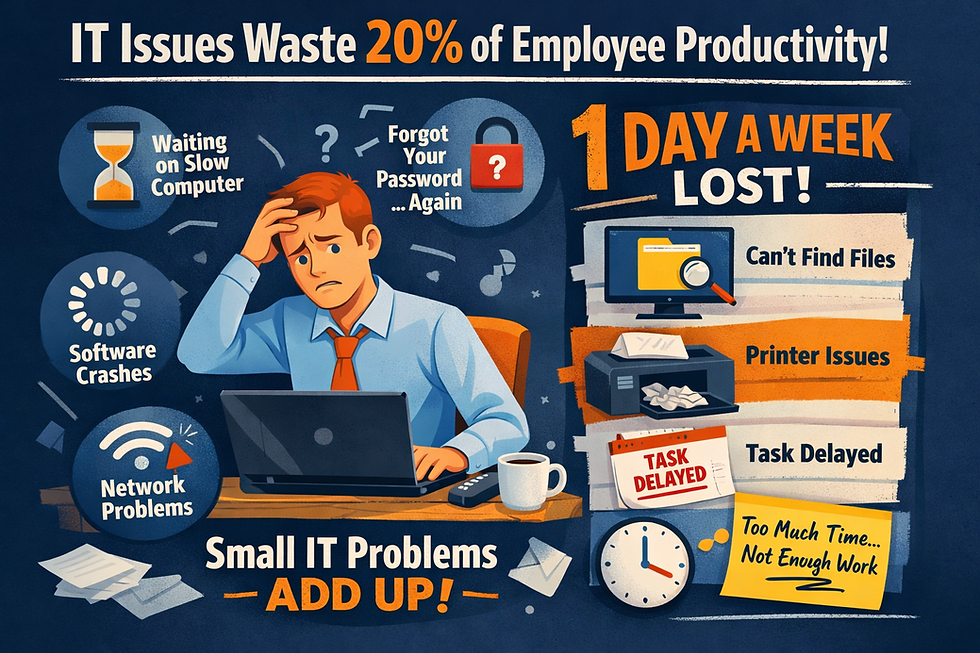
💻 Friday Fun Fact: IT Issues Waste 20% of Employee Productivity
🤔 Ever Feel Like Work Takes Longer Than It Should?
You sit down to start your day with a plan.
Answer emails. Knock out a few tasks. Make progress.
Then it starts…
Your computer takes a little too long to boot. A program freezes. You forgot your password (again).The file you need isn’t where it should be. The internet slows to a crawl right when you need it most.
None of these are major problems. But they all have one thing in common:
They interrupt your flow.
And once that flow is gone, it’s surprisingly hard to get it back.
📊 The Fun Fact
Employees can lose up to 20% of their work time dealing with IT-related issues.
That’s not just a statistic—it’s something most people experience every day without really thinking about it.
To put it in perspective:
That’s about 1 out of every 5 hours
Or roughly one full workday per week
Not from big system failures—but from small, constant friction.
🧩 Where Does the Time Actually Go?
When people hear “IT issues,” they often think of major outages.
But the real time loss usually comes from everyday annoyances like:
Waiting for slow systems to respond
Logging in multiple times across different tools
Resetting passwords or getting locked out
Apps freezing, crashing, or needing to be restarted
Searching for files, folders, or permissions
Dealing with printers, scanners, or shared drives
Switching between too many platforms that don’t sync well
Each one might only take a few minutes.
But they rarely happen just once.
⏳ The “Death by 1,000 Cuts” Effect
Let’s break it down in a realistic way:
5 minutes waiting on a slow application
3 minutes resetting a password
7 minutes dealing with a file access issue
5 minutes lost after getting distracted
That’s 20 minutes… and it’s not even noon yet.
By the end of the day, it’s easy to lose 45–60 minutes without realizing it.
And here’s the important part:
👉 Most people don’t track this time, so it feels normal.
🧠 It’s Not Just Time — It’s Mental Energy
The bigger impact isn’t always the minutes lost—it’s the context switching.
Every interruption forces your brain to:
Stop what it’s doing
Shift focus
Solve a new problem
Then try to get back on track
That process takes effort.
Even after the issue is resolved, it can take several minutes to fully regain focus.
So a 5-minute problem can easily turn into a 10–15 minute productivity loss.
😤 The Human Side of IT Friction
Over time, these small issues can affect more than just output.
They can lead to:
Low-level frustration throughout the day
Reduced motivation (“this shouldn’t be this hard”)
More breaks and distractions
Avoidance of certain tasks or tools
A general sense that work is harder than it needs to be
None of this shows up on a report—but it’s very real.
🔍 Why It Often Goes Unnoticed
There’s no alert that says:“⚠️ You just lost 37 minutes to IT issues today.”
Instead, it blends into the routine.
People adapt. They work around problems. They find shortcuts.
And eventually, those inefficiencies just become “how things are.”
🛠️ What Actually Helps (Without Overcomplicating Things)
Improving this doesn’t require a complete overhaul. It’s usually about reducing friction in small, consistent ways:
Systems that start quickly and run smoothly
Fewer logins and better password management
Tools that integrate instead of compete
Clear file organization and access
Fixing recurring problems instead of ignoring them
Paying attention to patterns (the same issue = real issue)
Sometimes the biggest improvements come from simply asking:
👉 “What slows people down the most during their day?”
🔄 A Different Way to Think About Productivity
Productivity isn’t just about working harder or faster.
It’s about removing the things that get in the way.
When systems work the way they should:
Tasks feel easier
Focus lasts longer
Work gets done with less effort
And the day feels… smoother.
🔐 Final Thought
Most productivity loss doesn’t come from major failures.
It comes from small, repeated interruptions that chip away at time and focus.
Fixing those isn’t always dramatic—but it’s one of the most effective ways to improve how work actually gets done.


Comments